“Why are you so pensive?” Asked the wall to the mirror.
“I reflect.” replied the mirror, rather curtly.
Thursday, April 10, 2008
Friday, March 28, 2008
Daughter Of Spring
Commuting to office has one benefit I must say, it gives me ample time to read and ruminate. So, the other day I was reading “The other side of the Moon” by Asha Miro in the bus. It is the true story of her adoption by a family in Barcelona and her search for her biological family in India. When she comes to India to know about her childhood, she looks for clues in every person she meets, everything she sees, hoping that somehow miraculously she’ll remember something, somehow the window to her past will open.
What if I did not know my birth date? I thought, imagining myself in a similar situation.
“I would know that I was born in spring.” I reasoned with myself almost instinctively.
Sounds strange, but I feel that I share a kind of relationship with spring. A season with renewal as its sole (soul) mantra; a season that celebrates life and death, together. The trees are riot of colors this time, it fills my heart with so much joy to see a tree in full bloom, but there is also a hint of inexplicable melancholy amidst this, which makes this feeling all the more absolute.
Yes all seasons evoke feelings and emotions in me, but it is spring that makes me feel nostalgic the most. It feels great to pine, I know not for what, and I languish in this nothingness, I do this very often in this season. Maybe it is all just psychological because I know I am a daughter of spring, but maybe just maybe the seasons we are born in do evoke strong feeling in us.
Let me know of the feelings the season of your birth evokes you.
P.S – Coincidentally my blog is a “daughter of spring too”. It was born on 22nd March last year and though it is hard to believe we have completed a wonderful year of togetherness.
What if I did not know my birth date? I thought, imagining myself in a similar situation.
“I would know that I was born in spring.” I reasoned with myself almost instinctively.
Sounds strange, but I feel that I share a kind of relationship with spring. A season with renewal as its sole (soul) mantra; a season that celebrates life and death, together. The trees are riot of colors this time, it fills my heart with so much joy to see a tree in full bloom, but there is also a hint of inexplicable melancholy amidst this, which makes this feeling all the more absolute.
Yes all seasons evoke feelings and emotions in me, but it is spring that makes me feel nostalgic the most. It feels great to pine, I know not for what, and I languish in this nothingness, I do this very often in this season. Maybe it is all just psychological because I know I am a daughter of spring, but maybe just maybe the seasons we are born in do evoke strong feeling in us.
Let me know of the feelings the season of your birth evokes you.
P.S – Coincidentally my blog is a “daughter of spring too”. It was born on 22nd March last year and though it is hard to believe we have completed a wonderful year of togetherness.
Labels:
March,
Musings,
Nostalgia,
Spring,
thoughts,
“Asha Miro”,
“The other side of the Moon”
Wednesday, March 26, 2008
Thought For Food Series 1: Idli

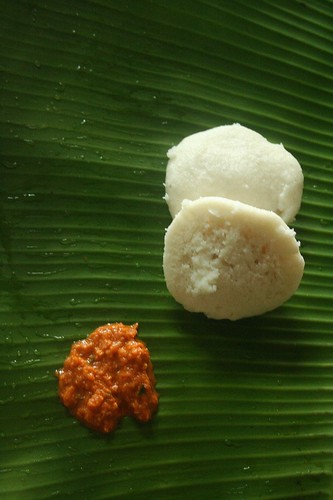
Breakfasts in South India are a yummy affair. You can choose from a variety of offerings, which are delicious and healthy at the same time. Idly is one of them, a popular breakfast snack not only in south India but all across India, it is one of my favorite breakfasts. For the uninitiated, it is a savory cake two to three inches in diameter made from fermented batter of rice and lentils. The batter after being fermented is put into specially molded trays that are in turn placed inside a pressure cooker. The batter gets cooked by the steam and out come the steaming hot idlis, supple but shapely.
Traditional South Indian meals are served on banana leaves which is a pragmatic and charming practice; there is a certain subtle taste that the banana leaves lend to the meal. Idly usually is served with accompaniments like chutney and sambar. Chutney is a blend of various spices and condiments where as sambar (not seen in the picture) is a vegetable stew with a hint of tamarind.
Now comes the best part, savoring the delicacy. Here it is the case of to each his own. I have seen people eat idly in a lot of different ways. Some like it mishmashed with the sambar and chutney the idly lost and assimilated in the hodgepodge best eaten with bare hands. Some prefer forks and spoons making little pieces of idly and dipping it in sambar and chutney in turns. I like to eat idli with my hands, dipping the idli in the sambar and letting it soak the essence, and then brushing it past the spicy chutney; it tastes yummylicious.
Happy Eating Folks!
P.S. – Now that I am roaming around a lot I get to try a lot of authentic traditional food, so will be posting about more dishes with yummy pictures. This particular picture was taken in Parambikulam before a trek. The plate is not mine, but my friend Nishka's. I had ordered dosas, which were delicious too! More about dosas some other time though.
Monday, March 10, 2008
Kambala: Racing Buffaloes, The Slushy Way
The rhythmic beat of drums and trumpets reverberates in the air. The area from where the sound emanates is jam-packed and I can barely see the goings on from my position. Camera in hand, I make way through the all men crowd dexterously, swinging my head to the intoxicating music.

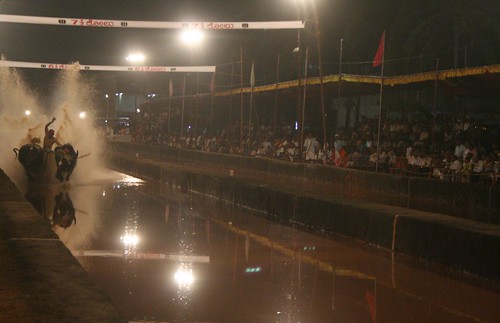
I find myself inside a unique arena (I had been expecting a marshy field all along); two tracks dug up and filled with slush run parallel to each other for about 450 ft. with the spectators’ stands adjacent to the two tracks with a well defined boundary to keep the spectators in check. The chaotic scenes that I had been imagining in my mind all the while are put to rest; Koti Chennaya Kambala organized at Puttur is a highly professional affair.
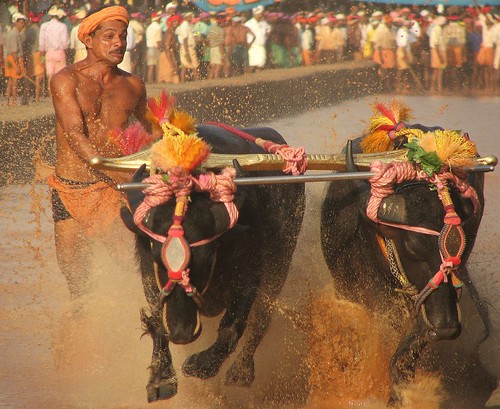
And this entire hullabaloo is for the buffaloes; paired with the help of a yoke they are lined up with their owners ready to enter the arena. Fresh after a pooja and a wash at the temple nearby, their black skin gleams in the blazing sun, they are decorated with fancy ropes, mirrors and some of them even sport amulets. The men are well sculpted; having a six-pack is no big deal here. Most of them are bare chested wearing just a modest lungi.

A man wearing a red turban and a matching lungi checks the buffaloes’ teeth with the air of a specialist. Checking for bad breadth? No. I later come to know that buffaloes are partitioned into different groups (small, medium and big I guess) according to the number of their fallen teeth. Ingenious, I must say!
An organizer is very happy to see my friends(Akshath and Srividya from the BWS gang.) and me, mistaking us for reporters as all of us are sporting cameras. When we inform him that we are just hobbyists he sportingly gives us the scarves which the volunteers are wearing. “Go close and shoot” he tells us in Kanadda and that’s exactly what we do, we have an up, close and personal encounter with the buffaloes of Puttur.


We position ourselves at the starting line. An enclosure is made for the buffaloes waiting in line for their turn; it is difficult to control some of them who are raring to be free and have a go at the slushy track. The main race will only start in the afternoon now is the time for the first timers to show their skills.
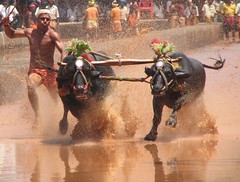
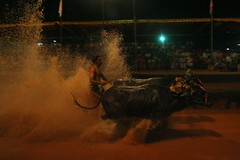
The first buffalo pair looks every bit menacing their muscles taut, quivering with excitement and their noses flaring. Agitated by the incessant whipping and war cries of the lone man (Saarthi) behind them, they rush past us at maddening speed leaving a trail of water flying behind.
“Splash, Splash, Splash!”

All this happens so fast that I fail to retract my camera in time and so it gets a generous helping of the mucky water. A fitting start to a day that is going to be action packed. No serious damage done though, thankfully. After a few runs I am taking pictures with the ease of a photographer seasoned for kambala.
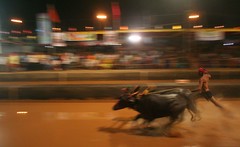
Some of the buffaloes cover the length of the track in a mere 10-15 seconds. I realize that running in water keeping pace with galloping buffaloes is no mean feat. Many a men fall in the slush, face down, unable to keep up with their more sturdy counterparts. But some men make it look really easy and I secretly wish to run in the slush; the muddy water does look tempting in this scorching sun. Maybe I’ll do this in Kadri Kambala sometime where there are races for women and children too sans the buffaloes.

The area around the arena dons a festive look; bhel and pani puri the ubiquitous Indian street food are present here too, “Pepsi Coca cola” a stereo announces running in a loop continuously, the pao-pao of the candy-floss (Oh! How I used to long for “Buddhi ki baal” as a kid!) Man’s cart adds to the din. We settle for a glass of sugarcane juice that as always is surprisingly refreshing.
Muthappa Rai looks down on us from huge posters, sporting a French beard and talking on a mobile phone. I find him good-looking quite contrary to the appearance I had expected when I had heard that he was a underworld don turned social worker. He hails from Puttur and is the organizer of the Koti Chennaya Kambala this year, which I later come to know, is the largest Kambala in Karnataka drawing a crowd of around a lakh people.


We now stand close to the finishing line that slants upwards; a simple braking mechanism to stop the buffaloes running at break neck speed. But still some of them crash straight into the crowd standing at the finishing line; some men rush with whips to control them and no harm is done.
As photography in the scorching sun is a tiring job, hunger pangs start making themselves felt in no time. There is some time for the main event to start, so we head towards a Akshath’s cousin’s place for lunch. I simply love the way these traditional homes are built, they are so inviting and cozy, and make you feel right at home. All characteristics of an ideal home I feel. The lunch is traditional Tulu fair and is yummylicious. Revitalized, after the lunch and a little rest we revisit the arena.
The bands are playing elaborately; the main event has started. The buffaloes are burlier now; they run even faster and splash more water in the process. I want to get some head-straight shots of the buffaloes so we join the freelance photographer with his bazooka like lens, who is already standing at the finishing line.
This is as adventurous as it gets! I point my camera on the buffaloes till I feel they are at a safe distance and then scamper inside the crowd for protection. The men look at me amused and sometimes I have the eerie feeling that the buffaloes too are eyeing me curiously, but then it is just a feeling. None of the buffaloes crash on us but we do have some close shaves.

As the evening matures it becomes even more cool and pleasant; the floodlights cast obscure reflections on the track. The dignitaries have started to arrive and the speeches on the stage run parallel to the commentary in the arena. Now comes the part for which I had been waiting for all through.

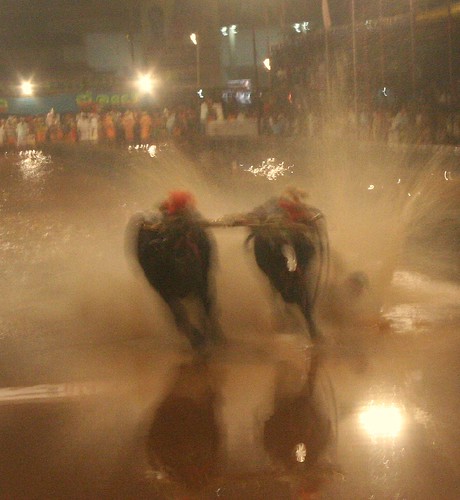
Kambala is not just about completing the stretch of the track in the least time, that is one aspect of the race. There is another unusual aspect too. In the middle of the track some markers are placed at the height of 6.5 and 7.5 feet respectively. The idea is that the splashing water should rise to this height. And for this the Saarthi has to stand on a plank attached to the buffaloes.

As the first pair with the Saarthi on the plank arrives it is a most bizarre sight. The blurred outline of a man is visible through the diaphanous film of water rising all around the buffaloes. The man himself seems to be hanging on to nothing but air and when they approach the middle of the track, where the markers are placed, the water astonishingly rises to great heights and manages to touch the 6.5 ft mark. I feel that the man has fallen into water by now but as the pair approaches the finishing line I am shocked to see that he is still there hanging on to the buffaloes.

Many buffaloes thus pass by, but none touch the 7.5 ft mark. But there is enough time; the competition will go on through the night ending only on Monday evening. And that reminds me that I have to be in office tomorrow. The night seems promising, Yakshagana is also supposed to happen and I’ve been wanting to watch one for quite sometime.


Loath that I am to leave I wonder at the juxtaposition of the two different lives I seem to live on the weekdays and weekends. I’ve been really lucky to have watched Kambala; the one in Puttur is amongst the last to happen during the Kambala season, which starts from Dec. and goes on till March. Thanks to Pavan for digging out the info and arranging the trip!Information about the Kambala schedule is hard to get by on the internet, but I promise myself to come back for the Kambala next year, if not Puttur some other location. After Jallikattu and Kambala I want my tryst with rural sports to continue.

I find myself inside a unique arena (I had been expecting a marshy field all along); two tracks dug up and filled with slush run parallel to each other for about 450 ft. with the spectators’ stands adjacent to the two tracks with a well defined boundary to keep the spectators in check. The chaotic scenes that I had been imagining in my mind all the while are put to rest; Koti Chennaya Kambala organized at Puttur is a highly professional affair.
And this entire hullabaloo is for the buffaloes; paired with the help of a yoke they are lined up with their owners ready to enter the arena. Fresh after a pooja and a wash at the temple nearby, their black skin gleams in the blazing sun, they are decorated with fancy ropes, mirrors and some of them even sport amulets. The men are well sculpted; having a six-pack is no big deal here. Most of them are bare chested wearing just a modest lungi.

A man wearing a red turban and a matching lungi checks the buffaloes’ teeth with the air of a specialist. Checking for bad breadth? No. I later come to know that buffaloes are partitioned into different groups (small, medium and big I guess) according to the number of their fallen teeth. Ingenious, I must say!
An organizer is very happy to see my friends(Akshath and Srividya from the BWS gang.) and me, mistaking us for reporters as all of us are sporting cameras. When we inform him that we are just hobbyists he sportingly gives us the scarves which the volunteers are wearing. “Go close and shoot” he tells us in Kanadda and that’s exactly what we do, we have an up, close and personal encounter with the buffaloes of Puttur.


We position ourselves at the starting line. An enclosure is made for the buffaloes waiting in line for their turn; it is difficult to control some of them who are raring to be free and have a go at the slushy track. The main race will only start in the afternoon now is the time for the first timers to show their skills.
The first buffalo pair looks every bit menacing their muscles taut, quivering with excitement and their noses flaring. Agitated by the incessant whipping and war cries of the lone man (Saarthi) behind them, they rush past us at maddening speed leaving a trail of water flying behind.
“Splash, Splash, Splash!”

All this happens so fast that I fail to retract my camera in time and so it gets a generous helping of the mucky water. A fitting start to a day that is going to be action packed. No serious damage done though, thankfully. After a few runs I am taking pictures with the ease of a photographer seasoned for kambala.
Some of the buffaloes cover the length of the track in a mere 10-15 seconds. I realize that running in water keeping pace with galloping buffaloes is no mean feat. Many a men fall in the slush, face down, unable to keep up with their more sturdy counterparts. But some men make it look really easy and I secretly wish to run in the slush; the muddy water does look tempting in this scorching sun. Maybe I’ll do this in Kadri Kambala sometime where there are races for women and children too sans the buffaloes.

The area around the arena dons a festive look; bhel and pani puri the ubiquitous Indian street food are present here too, “Pepsi Coca cola” a stereo announces running in a loop continuously, the pao-pao of the candy-floss (Oh! How I used to long for “Buddhi ki baal” as a kid!) Man’s cart adds to the din. We settle for a glass of sugarcane juice that as always is surprisingly refreshing.
Muthappa Rai looks down on us from huge posters, sporting a French beard and talking on a mobile phone. I find him good-looking quite contrary to the appearance I had expected when I had heard that he was a underworld don turned social worker. He hails from Puttur and is the organizer of the Koti Chennaya Kambala this year, which I later come to know, is the largest Kambala in Karnataka drawing a crowd of around a lakh people.


We now stand close to the finishing line that slants upwards; a simple braking mechanism to stop the buffaloes running at break neck speed. But still some of them crash straight into the crowd standing at the finishing line; some men rush with whips to control them and no harm is done.
As photography in the scorching sun is a tiring job, hunger pangs start making themselves felt in no time. There is some time for the main event to start, so we head towards a Akshath’s cousin’s place for lunch. I simply love the way these traditional homes are built, they are so inviting and cozy, and make you feel right at home. All characteristics of an ideal home I feel. The lunch is traditional Tulu fair and is yummylicious. Revitalized, after the lunch and a little rest we revisit the arena.
The bands are playing elaborately; the main event has started. The buffaloes are burlier now; they run even faster and splash more water in the process. I want to get some head-straight shots of the buffaloes so we join the freelance photographer with his bazooka like lens, who is already standing at the finishing line.
This is as adventurous as it gets! I point my camera on the buffaloes till I feel they are at a safe distance and then scamper inside the crowd for protection. The men look at me amused and sometimes I have the eerie feeling that the buffaloes too are eyeing me curiously, but then it is just a feeling. None of the buffaloes crash on us but we do have some close shaves.

As the evening matures it becomes even more cool and pleasant; the floodlights cast obscure reflections on the track. The dignitaries have started to arrive and the speeches on the stage run parallel to the commentary in the arena. Now comes the part for which I had been waiting for all through.

Kambala is not just about completing the stretch of the track in the least time, that is one aspect of the race. There is another unusual aspect too. In the middle of the track some markers are placed at the height of 6.5 and 7.5 feet respectively. The idea is that the splashing water should rise to this height. And for this the Saarthi has to stand on a plank attached to the buffaloes.

As the first pair with the Saarthi on the plank arrives it is a most bizarre sight. The blurred outline of a man is visible through the diaphanous film of water rising all around the buffaloes. The man himself seems to be hanging on to nothing but air and when they approach the middle of the track, where the markers are placed, the water astonishingly rises to great heights and manages to touch the 6.5 ft mark. I feel that the man has fallen into water by now but as the pair approaches the finishing line I am shocked to see that he is still there hanging on to the buffaloes.

Many buffaloes thus pass by, but none touch the 7.5 ft mark. But there is enough time; the competition will go on through the night ending only on Monday evening. And that reminds me that I have to be in office tomorrow. The night seems promising, Yakshagana is also supposed to happen and I’ve been wanting to watch one for quite sometime.


Loath that I am to leave I wonder at the juxtaposition of the two different lives I seem to live on the weekdays and weekends. I’ve been really lucky to have watched Kambala; the one in Puttur is amongst the last to happen during the Kambala season, which starts from Dec. and goes on till March. Thanks to Pavan for digging out the info and arranging the trip!Information about the Kambala schedule is hard to get by on the internet, but I promise myself to come back for the Kambala next year, if not Puttur some other location. After Jallikattu and Kambala I want my tryst with rural sports to continue.
Friday, March 7, 2008
The Ultimate Greed
To and fro, To and fro, her fingers go, round the candle’s wick.
“This is fun.” she thinks, “Ohh! What a trick!”
Her saree well draped,
The flow of fire, liquid.
Her delicate anklets tinkling,
The burning feet.
To and fro, To and fro, her fingers go, round the candle’s wick.
“This is fun.” she thinks, “Ohh! What a trick!”
The tongue of fire,
Her lush dark hair;
The jasmine fragrance fading;
The overpowering reek.
To and fro, To and fro, her fingers go, round the candle’s wick.
“This is fun.” she thinks, “Ohh! What a trick!”
Her lovely face, melting,
Her teary eyes, sparkling.
Her gasps for breath, heaving,
Her cries for relief.
To and fro, To and fro, her fingers go, round the candle’s wick.
“This is fun.” she thinks, “Ohh! What a trick!”

Women, both of them,
The killer and the victim.
One plays with the candle,
The other is the wick.
To and fro, To and fro, her fingers go, round the candle’s wick.
“This is fun.” she thinks, “Ohh! What a trick!”
Her smile, smug, contorted
Her gaze, intense hatred.
Her eyes eager, hungry;
The ultimate greed.
To and fro, To and fro, her fingers go, round the candle’s wick.
“This is fun.” she thinks, “Ohh! What a trick!”
A voice against Dowry Deaths, on Women's day.
Cross-posted on Writer's blend and Desicritics
“This is fun.” she thinks, “Ohh! What a trick!”
Her saree well draped,
The flow of fire, liquid.
Her delicate anklets tinkling,
The burning feet.
To and fro, To and fro, her fingers go, round the candle’s wick.
“This is fun.” she thinks, “Ohh! What a trick!”
The tongue of fire,
Her lush dark hair;
The jasmine fragrance fading;
The overpowering reek.
To and fro, To and fro, her fingers go, round the candle’s wick.
“This is fun.” she thinks, “Ohh! What a trick!”
Her lovely face, melting,
Her teary eyes, sparkling.
Her gasps for breath, heaving,
Her cries for relief.
To and fro, To and fro, her fingers go, round the candle’s wick.
“This is fun.” she thinks, “Ohh! What a trick!”

Women, both of them,
The killer and the victim.
One plays with the candle,
The other is the wick.
To and fro, To and fro, her fingers go, round the candle’s wick.
“This is fun.” she thinks, “Ohh! What a trick!”
Her smile, smug, contorted
Her gaze, intense hatred.
Her eyes eager, hungry;
The ultimate greed.
To and fro, To and fro, her fingers go, round the candle’s wick.
“This is fun.” she thinks, “Ohh! What a trick!”
A voice against Dowry Deaths, on Women's day.
Cross-posted on Writer's blend and Desicritics
Thursday, February 28, 2008
Skandagiri : The Stuff Dreams Are Made Of
I call up my Mom just after office on Thursday night. Sample the conversation.
Me : “I am going on trek.”
Mum (surprised) : “Today is Friday?”
Me : “No, its Thursday, But I am going on a moonlight trek”
Mum (shocked): What about office tomorrow?
Me : “I’ll come back by morning.”
Mum : “Tu pagal hai” (Your’re mad.)
So I’ve been traveling like crazy on weekends for the last two months much to my parents’ chagrin. But the idea of a night trek to Skandagiri (aka Kalwarbetta) on a weekday was a little too insane even by my standards.
I’ve never been on a night trek before and when an opportunity for a trek on a full moon night with the BWS gang presents itself, I won’t miss it, come what may. So after rushing through a meeting at office I take an auto from Maratahalli to Hebbal (Ignorant that I would’ve to shell out three hundred bucks for it) to meet the rest of the gang.
Post dinner we head for Skandagiri , which is around 75 Kms from Bangalore close to the more famous Nandi Hills . Tired after a long day I promptly doze off as soon as I get into the car, getting up only when we’ve reached the foot of Skandagiri.
The night is beautiful; the moon is beaming in the sky stealing the glory from the stars, which twinkle half-heartedly. I can make out the rugged outlines of the hill we’ve to climb, it doesn’t look even a wee bit intimidating in the night. A pleasant breeze is blowing I find my sleepiness being replaced by excitement and slowly I feel fully awakened to the night.

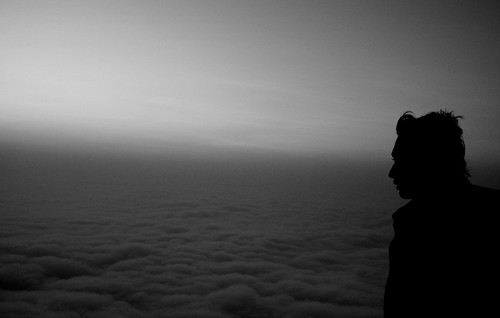
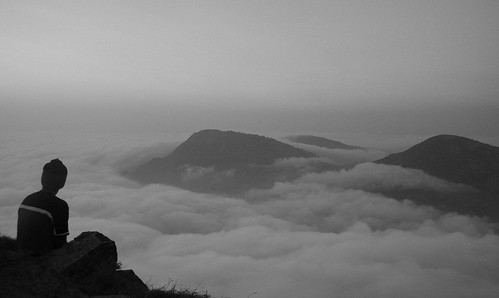
A fellow trekker waiting for the sun to rise
We start walking without torches, which have been rendered useless owning to the bright moonlight, with our guide and his dog showing the way. The terrain is arid the only vegetation being the thorny bushes and dried grass interspersed along the way. The huddled lights of Chikballapur are visible after a distance making for a lovely sight. The climb is not too steep but still we tire off after walking only for a few minutes, so much for the sedentary lifestyles most of us lead.
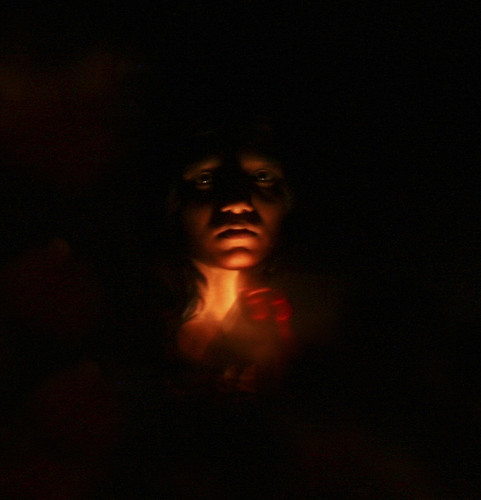
We may be tired, but never too tired for photography. The cameras and the tripods come out rolling, with people experimenting some long exposure group shots by flashing the torchlight on each of the group member’s face progressively. The guide looks amused at all this but pushes us to start walking again.

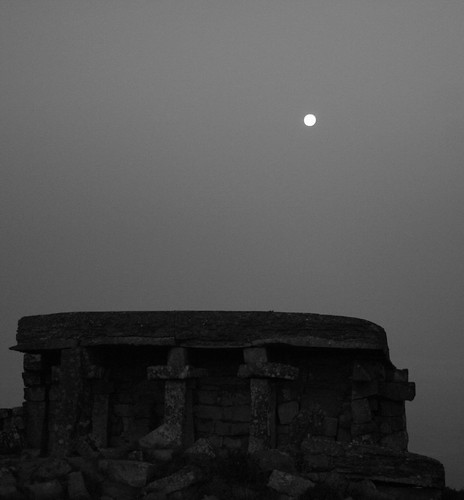
The temple at the peak before the sunrise
But we walk slowly, drinking in the surroundings, snacking on kismish and chips, taking frequent breaks, lazing on the rocks sometimes even dozing off as the breeze pleasantly fans us. As we go higher the wind grows stronger making my hair fly wildly, mist also starts to gather shrouding the adjacent peaks.

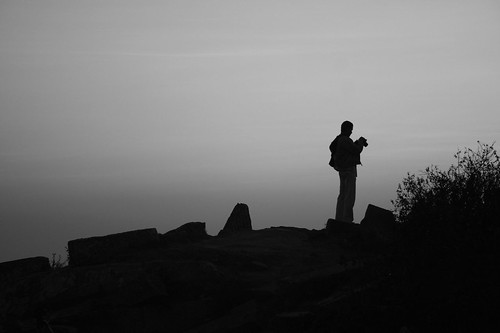
Few fellow photo-trekker postioned at the peak with their gear
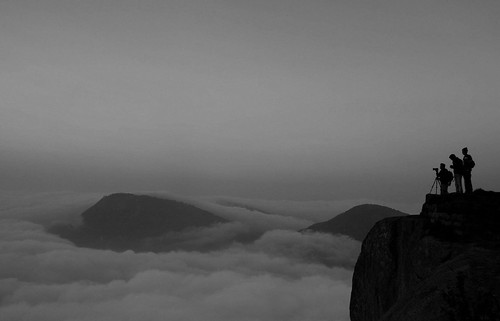
Thus we reach the peak, Nandi-the bull a fixture in most of the South Indian temples welcomes us. We stand at the cliff for sometime braving the winds; I could very well fly given my weight. Nandi hills is visible in the distance. An ancient temple stands on the peak alone, providing a haven from the gutsy wings. People busy themselves; some try to pitch tents as they thrash noisily, some struggle to start a bonfire whereas I snuggle inside my sleeping bag.
I wish the total lunar eclipse were visible in India too, I’ve seen only two total lunar eclipses till now. The first, through our bedroom window early on a summer morning some ten years back. I had made sure that everyone in the house was awake to witness the breathtaking sight. The second, in March last year, again early in the morning from the terrace of my abode in Bangalore and this time too, though I was away from home, my frequent calls made sure that my parents and sister didn’t miss it.
Thus, thinking and dreaming of lunar eclipses and breathtaking sights I fall asleep inside the temple only to wake up to another dream.
Adjectives fail to describe the heady sight before us, so we fall back on nouns, heaven and dream could be the two befitting terms used to describe the sight. The moon has not set yet and it glows eerily through the mist. Sheets of cloud hiding the valley below appear so cushiony that I am almost tempted to take a plunge.
A faint orange is discernible on one part of the sky marking the direction for the sunrise.


Musings
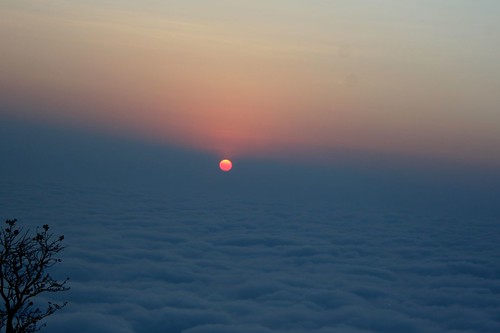
All the sunrises I’ve seen recently I’ve felt that the sun rises a little too fast and it becomes harsh on the eyes a little too soon. But not at Skandagiri, the sun here rises with a sluggish grace, its brilliance sifted through the clouds and mist is a joy for the eyes. And as the sun rises on the firmament taking a cue from it the clouds rise too and cover the Sun, as if this is a game they are accustomed to play.

Sunrise
We stay at the peak for some more time living the dream, but then the realities of the other world make themselves felt. Most of us have to attend office, so reluctantly we start back for the base. My legs shake as I go down the muddy slopes; the very idea of going to office now feels like crazy and the idea of a trek on a weekday even a crazier. “Sur, you’re mad.” I tell myself.
I am glad that I am.

Sunrise
Cross posted on Desicritics.
Me : “I am going on trek.”
Mum (surprised) : “Today is Friday?”
Me : “No, its Thursday, But I am going on a moonlight trek”
Mum (shocked): What about office tomorrow?
Me : “I’ll come back by morning.”
Mum : “Tu pagal hai” (Your’re mad.)
So I’ve been traveling like crazy on weekends for the last two months much to my parents’ chagrin. But the idea of a night trek to Skandagiri (aka Kalwarbetta) on a weekday was a little too insane even by my standards.
I’ve never been on a night trek before and when an opportunity for a trek on a full moon night with the BWS gang presents itself, I won’t miss it, come what may. So after rushing through a meeting at office I take an auto from Maratahalli to Hebbal (Ignorant that I would’ve to shell out three hundred bucks for it) to meet the rest of the gang.
Post dinner we head for Skandagiri , which is around 75 Kms from Bangalore close to the more famous Nandi Hills . Tired after a long day I promptly doze off as soon as I get into the car, getting up only when we’ve reached the foot of Skandagiri.
The night is beautiful; the moon is beaming in the sky stealing the glory from the stars, which twinkle half-heartedly. I can make out the rugged outlines of the hill we’ve to climb, it doesn’t look even a wee bit intimidating in the night. A pleasant breeze is blowing I find my sleepiness being replaced by excitement and slowly I feel fully awakened to the night.

A fellow trekker waiting for the sun to rise
We start walking without torches, which have been rendered useless owning to the bright moonlight, with our guide and his dog showing the way. The terrain is arid the only vegetation being the thorny bushes and dried grass interspersed along the way. The huddled lights of Chikballapur are visible after a distance making for a lovely sight. The climb is not too steep but still we tire off after walking only for a few minutes, so much for the sedentary lifestyles most of us lead.
We may be tired, but never too tired for photography. The cameras and the tripods come out rolling, with people experimenting some long exposure group shots by flashing the torchlight on each of the group member’s face progressively. The guide looks amused at all this but pushes us to start walking again.

The temple at the peak before the sunrise
But we walk slowly, drinking in the surroundings, snacking on kismish and chips, taking frequent breaks, lazing on the rocks sometimes even dozing off as the breeze pleasantly fans us. As we go higher the wind grows stronger making my hair fly wildly, mist also starts to gather shrouding the adjacent peaks.

Few fellow photo-trekker postioned at the peak with their gear
Thus we reach the peak, Nandi-the bull a fixture in most of the South Indian temples welcomes us. We stand at the cliff for sometime braving the winds; I could very well fly given my weight. Nandi hills is visible in the distance. An ancient temple stands on the peak alone, providing a haven from the gutsy wings. People busy themselves; some try to pitch tents as they thrash noisily, some struggle to start a bonfire whereas I snuggle inside my sleeping bag.
I wish the total lunar eclipse were visible in India too, I’ve seen only two total lunar eclipses till now. The first, through our bedroom window early on a summer morning some ten years back. I had made sure that everyone in the house was awake to witness the breathtaking sight. The second, in March last year, again early in the morning from the terrace of my abode in Bangalore and this time too, though I was away from home, my frequent calls made sure that my parents and sister didn’t miss it.
Thus, thinking and dreaming of lunar eclipses and breathtaking sights I fall asleep inside the temple only to wake up to another dream.
Adjectives fail to describe the heady sight before us, so we fall back on nouns, heaven and dream could be the two befitting terms used to describe the sight. The moon has not set yet and it glows eerily through the mist. Sheets of cloud hiding the valley below appear so cushiony that I am almost tempted to take a plunge.
A faint orange is discernible on one part of the sky marking the direction for the sunrise.


Musings
All the sunrises I’ve seen recently I’ve felt that the sun rises a little too fast and it becomes harsh on the eyes a little too soon. But not at Skandagiri, the sun here rises with a sluggish grace, its brilliance sifted through the clouds and mist is a joy for the eyes. And as the sun rises on the firmament taking a cue from it the clouds rise too and cover the Sun, as if this is a game they are accustomed to play.

Sunrise
We stay at the peak for some more time living the dream, but then the realities of the other world make themselves felt. Most of us have to attend office, so reluctantly we start back for the base. My legs shake as I go down the muddy slopes; the very idea of going to office now feels like crazy and the idea of a trek on a weekday even a crazier. “Sur, you’re mad.” I tell myself.
I am glad that I am.

Sunrise
Cross posted on Desicritics.
Labels:
DC,
Moonlight,
Photography,
Skandagiri,
Sunrise,
travel,
trek
Tuesday, February 12, 2008
Jallikattu: Bull Taming in Thammampatti
The juggernaut
A sea of humans swells and ebbs in Thammampatti, a small town near Salem in Tamil Nadu. There are people everywhere easily tens of thousands; they flood the roads filling the narrow alleys, their eager faces gaze down from rooftops, they are perched precariously on bamboo scaffoldings to get a better look. And then comes the juggernaut, the bull.
Festooned with gulal, ribbons and garlands and moving its head agitatedly showing off the razor-sharp horns it tears past the mass of humans. A hush engulfs the crowd and the excitement is palpable. The not-so-brave scamper to shelter themselves from the onslaught; the barricades are no match to the brute force of the beast. The alley, which looked jam-packed just one moment back, miraculously gives way.

Horns, Hump and tail: Different folks, Different Strokes
The brave and the not-so-brave
A few brave men venture forward; almost all of them are in high spirits, literally and figuratively speaking. The most audacious among them make an attempt for the bull’s hump, the not-so-daring make for its tail and the puniest among them are content to just touch the bull and beat it once.
The scene gets repeated many times with myriad variations.
A muscular man who looks smug holding on to the bull’s tail, is shaken off the next moment and falls violently on the ground; an anxious murmur rises from the crowd but the very next moment he is back on his feet looking smug again.

Don’t mess with me!
The bull corners a man and they stare at each other, eyes unblinking. The scene looks straight out of a typical Bollywood movie, the crowd holds on to its breath, another man lunges for the bull from behind and the fellow in front runs for his life.

Two hot to handle!
A bull is goring a group of men; it is black in color with its skin gleaming in the hot Sun. Till now it has shaken off everyone who has tried to get on it. And suddenly without any warning another burly black bull crashes into the crowd.
A rather lanky fellow in shiny blue jersey and shorts holds on to the hump of the bull with a triumphant look on his face and the crowd goes giddy with joy.
Bull taming, Indian Style
This is Jallikattu for you, an ancient bull taming sport played in Tamil Nadu, India as a part of the celebrations of harvest festival, Pongal. The ritual dates back to 2000 years, in fact there are several rock paintings, at remote Karikkiyur village in the Nilgiris district in Tamil Nadu that show men chasing bulls.
A particularly ferocious species of bull, the Kangeyam bull is let on rampage and taming it without any weapon whatsoever is taken as a mark of masculinity. The man who holds on to the bull from the entrance of the bull pen to the marker can boast about it all round the year, and of course he is entitled to the prizes like cash, watches, lungis, cookers etc. Legend has it that in earlier days women used the game to choose their husbands.
But what am I doing here? Certainly not looking for potential husbands.

All for glory?
The electric atmosphere
I am standing delicately on a rooftop; I feel as if I don’t even have enough room to wink my eyelids. I have my weapon in my hand, my new camera Canon Rebel XT on which dust has already started settling. My fellow shutterbugs are somewhere around, lost in the throng, busy capturing the event through their lenses.

The throng
The sun is beating down on us relentlessly; the odor of sweat mingling with dry air is omnipresent. An ice candy man has found room in the street down amidst the commotion and he is selling orange candies. I lust these sweetmeats, but make do with water for now, I don’t want to lose this spot, which presents a good view of the alley down.
The commetator’s voice punctuates the already tense air; I don’t understand a thing, my knowledge of Tamil being limited to a few unmentionable expletives and movie songs. But my friends tell me later that the commentator announces the prize money attached to a particular bull thus goading and enticing men to run for it.
And do the already charged men need any goading? They fall on the bull without any prompting.

A kid in the safe hands of his granny
You need a funny bone
There are light moments too, in the otherwise violent and charged atmosphere.
A man looking abashed is being pulled back home forcefully by his wife, who certainly doesn’t looked amused by the idea of her husband taming the bull and in turn being gored by it.
A silence falls over the crowd in expectance of the bull, but a collective laughter rises from the crowd as the object of curiosity turns out to be a dog.
A local enthusiastically tells me that this happens only in Tamil Nadu, I want to tell him about the Spanish bullfights, but by now I’ve realized that Jallikattu is quite different. Unlike the Spanish bullfights Jallikattu does not end with the death of the bull. And moreover I don’t want to puncture his enthusiasm so I nod at him smiling.
Earlier in the day we had visited a bullpen. The bulls specially bred for Jallikattu are brought from districts near and far, some on foot and some hauled on small tempos. Even when tied to a leash it takes at least two to three men to control a bull.
The balance in this sport is tilted in the bull’s favor if you consider the raw power of a bull against that of a single man. But when its one bull against the crowd the balance gets skewed and in Thammampatti I saw this happening quite often.

One Against Many: A Skewed Balance
Surviving Jallikattu, unscraped
But even when the throng is against the bull there are cases of injuries, it is not a place for the timid hearted, and blood shed is commonplace here. The Supreme Court of India had banned Jallikattu, but it revoked the ban under the condition that necessary precautions would be taken to prevent cruelty to animals and injuries to humans.
And precautions are taken in Thammampatti, an ambulance is doing rounds of the alleys, bulls are subjected to a round of screening before the event, police personnels are posted all along the street though they are having a hard time controlling the staggering crowd.
The throng carries on enthusiastically till the last bull is brought out. The sun is all set to dip. The crowd, tired after a hard day, disperses. The street vendors selling idli, vada and other South Indian delicacies are doing a brisk business. We indulge in some yummy street food before we start back for Bangalore.
The next day as I read the newspapers I come to know that around 70 persons were injured in the Jallikattu in Thammampatti, much less than the count last year. Given that there have been two hundred casualties in Jallikattu in the last one decade, the Supreme Court ban though revoked seems to have made this sport a little safe at least. I send a silent prayer to my Gods for having survived my friends and me unscraped through Jallikattu, though a bizarre one at that, Jallikattu was an experience worth having.
*gulal - Colored powder
*lungi - A garment worn round the waist.
*idli - A savory cake made of batter of fermented rice, black lentils and fenugreek, a popular snack throughout South India.
*vada - A dough nut shaped South Indian delicacy made from lentil.
A sea of humans swells and ebbs in Thammampatti, a small town near Salem in Tamil Nadu. There are people everywhere easily tens of thousands; they flood the roads filling the narrow alleys, their eager faces gaze down from rooftops, they are perched precariously on bamboo scaffoldings to get a better look. And then comes the juggernaut, the bull.
Festooned with gulal, ribbons and garlands and moving its head agitatedly showing off the razor-sharp horns it tears past the mass of humans. A hush engulfs the crowd and the excitement is palpable. The not-so-brave scamper to shelter themselves from the onslaught; the barricades are no match to the brute force of the beast. The alley, which looked jam-packed just one moment back, miraculously gives way.

Horns, Hump and tail: Different folks, Different Strokes
The brave and the not-so-brave
A few brave men venture forward; almost all of them are in high spirits, literally and figuratively speaking. The most audacious among them make an attempt for the bull’s hump, the not-so-daring make for its tail and the puniest among them are content to just touch the bull and beat it once.
The scene gets repeated many times with myriad variations.
A muscular man who looks smug holding on to the bull’s tail, is shaken off the next moment and falls violently on the ground; an anxious murmur rises from the crowd but the very next moment he is back on his feet looking smug again.

Don’t mess with me!
The bull corners a man and they stare at each other, eyes unblinking. The scene looks straight out of a typical Bollywood movie, the crowd holds on to its breath, another man lunges for the bull from behind and the fellow in front runs for his life.

Two hot to handle!
A bull is goring a group of men; it is black in color with its skin gleaming in the hot Sun. Till now it has shaken off everyone who has tried to get on it. And suddenly without any warning another burly black bull crashes into the crowd.
A rather lanky fellow in shiny blue jersey and shorts holds on to the hump of the bull with a triumphant look on his face and the crowd goes giddy with joy.
Bull taming, Indian Style
This is Jallikattu for you, an ancient bull taming sport played in Tamil Nadu, India as a part of the celebrations of harvest festival, Pongal. The ritual dates back to 2000 years, in fact there are several rock paintings, at remote Karikkiyur village in the Nilgiris district in Tamil Nadu that show men chasing bulls.
A particularly ferocious species of bull, the Kangeyam bull is let on rampage and taming it without any weapon whatsoever is taken as a mark of masculinity. The man who holds on to the bull from the entrance of the bull pen to the marker can boast about it all round the year, and of course he is entitled to the prizes like cash, watches, lungis, cookers etc. Legend has it that in earlier days women used the game to choose their husbands.
But what am I doing here? Certainly not looking for potential husbands.

All for glory?
The electric atmosphere
I am standing delicately on a rooftop; I feel as if I don’t even have enough room to wink my eyelids. I have my weapon in my hand, my new camera Canon Rebel XT on which dust has already started settling. My fellow shutterbugs are somewhere around, lost in the throng, busy capturing the event through their lenses.

The throng
The sun is beating down on us relentlessly; the odor of sweat mingling with dry air is omnipresent. An ice candy man has found room in the street down amidst the commotion and he is selling orange candies. I lust these sweetmeats, but make do with water for now, I don’t want to lose this spot, which presents a good view of the alley down.
The commetator’s voice punctuates the already tense air; I don’t understand a thing, my knowledge of Tamil being limited to a few unmentionable expletives and movie songs. But my friends tell me later that the commentator announces the prize money attached to a particular bull thus goading and enticing men to run for it.
And do the already charged men need any goading? They fall on the bull without any prompting.

A kid in the safe hands of his granny
You need a funny bone
There are light moments too, in the otherwise violent and charged atmosphere.
A man looking abashed is being pulled back home forcefully by his wife, who certainly doesn’t looked amused by the idea of her husband taming the bull and in turn being gored by it.
A silence falls over the crowd in expectance of the bull, but a collective laughter rises from the crowd as the object of curiosity turns out to be a dog.
A local enthusiastically tells me that this happens only in Tamil Nadu, I want to tell him about the Spanish bullfights, but by now I’ve realized that Jallikattu is quite different. Unlike the Spanish bullfights Jallikattu does not end with the death of the bull. And moreover I don’t want to puncture his enthusiasm so I nod at him smiling.
Earlier in the day we had visited a bullpen. The bulls specially bred for Jallikattu are brought from districts near and far, some on foot and some hauled on small tempos. Even when tied to a leash it takes at least two to three men to control a bull.
The balance in this sport is tilted in the bull’s favor if you consider the raw power of a bull against that of a single man. But when its one bull against the crowd the balance gets skewed and in Thammampatti I saw this happening quite often.

One Against Many: A Skewed Balance
Surviving Jallikattu, unscraped
But even when the throng is against the bull there are cases of injuries, it is not a place for the timid hearted, and blood shed is commonplace here. The Supreme Court of India had banned Jallikattu, but it revoked the ban under the condition that necessary precautions would be taken to prevent cruelty to animals and injuries to humans.
And precautions are taken in Thammampatti, an ambulance is doing rounds of the alleys, bulls are subjected to a round of screening before the event, police personnels are posted all along the street though they are having a hard time controlling the staggering crowd.
The throng carries on enthusiastically till the last bull is brought out. The sun is all set to dip. The crowd, tired after a hard day, disperses. The street vendors selling idli, vada and other South Indian delicacies are doing a brisk business. We indulge in some yummy street food before we start back for Bangalore.
The next day as I read the newspapers I come to know that around 70 persons were injured in the Jallikattu in Thammampatti, much less than the count last year. Given that there have been two hundred casualties in Jallikattu in the last one decade, the Supreme Court ban though revoked seems to have made this sport a little safe at least. I send a silent prayer to my Gods for having survived my friends and me unscraped through Jallikattu, though a bizarre one at that, Jallikattu was an experience worth having.
*gulal - Colored powder
*lungi - A garment worn round the waist.
*idli - A savory cake made of batter of fermented rice, black lentils and fenugreek, a popular snack throughout South India.
*vada - A dough nut shaped South Indian delicacy made from lentil.
Labels:
Jallikattu,
Photography,
Sports,
Thammampatti,
travel,
“Bull Chasing”,
“Bull Taming”,
“Tamil Nadu”
Subscribe to:
Posts (Atom)